The Cosmic Cauldron of Metamorphosis between East and West
Historical Introduction: The Three Feet of Sovereignty between Greece and China
In the pages of The Marriage of Cadmus and Harmony, Roberto Calasso describes Delphi as the magnetic center where the numinous turns into word. At the heart of the Apollonian sanctuary stands not a throne, but the bronze tripod: the seat upon which the Pythia sits suspended above the fissure of the Earth to inhale the vapors and extract the oracle.
Concurrently, thousands of miles away, the Chinese civilization of the Shang and Zhou dynasties grounded its concept of sacred power upon the Ding (), massive cast-bronze tripods. In ancient China, ownership of the Nine Ritual Tripods (Jiǔ Dǐng) legitimized the Mandate of Heaven (Tiānmìng): whoever possessed the tripods possessed the pivot of the empire.
Both in the West and in the East, archaic humanity understood that the symbolism of the bronze tripod does not belong to simple domestic utility, but marks the tangible boundary where the divine meets matter through fire.
1. The Archetypal Structure: Why Three Feet?
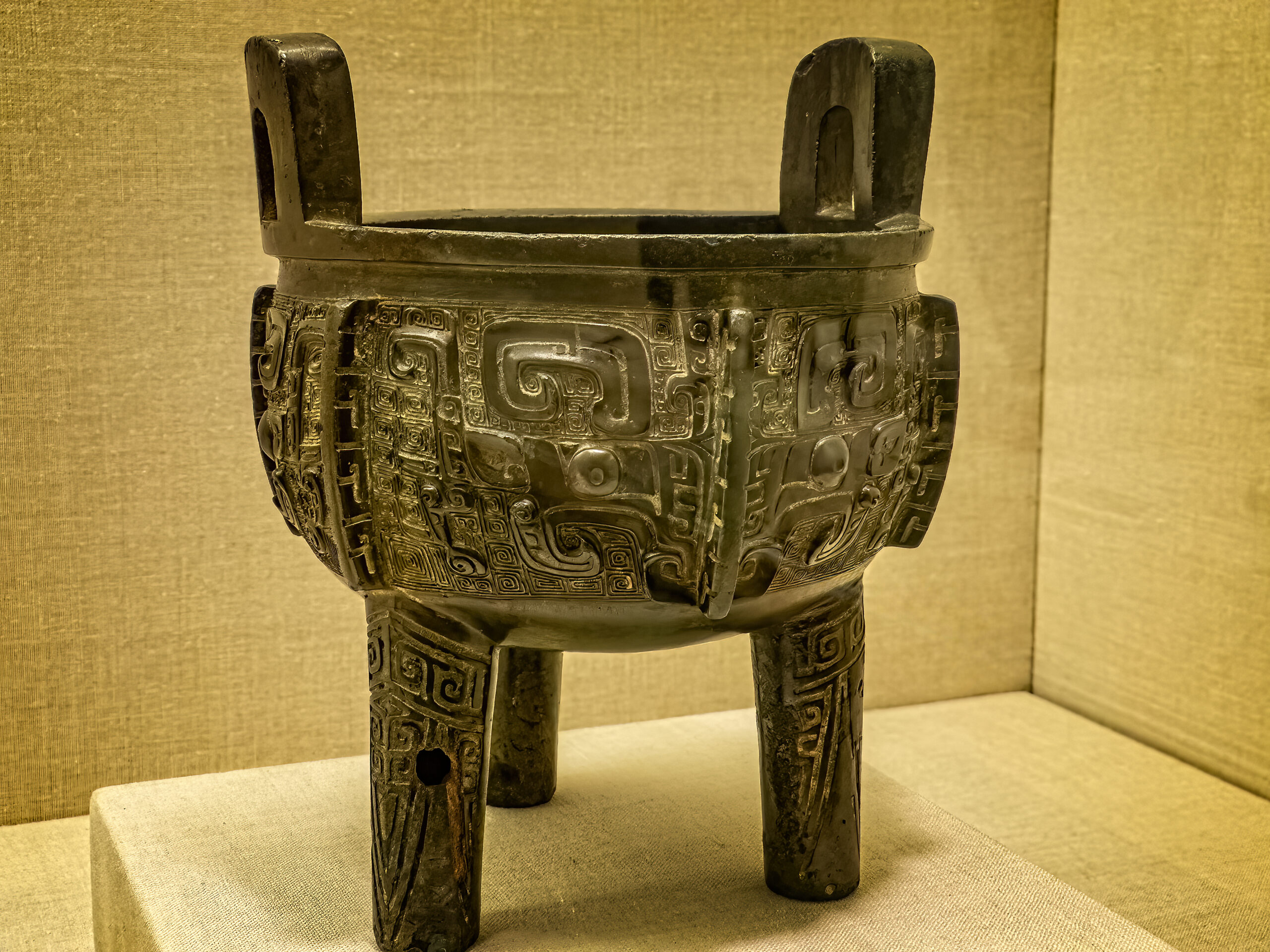
In sacred geometry and alchemy, four is the number of fixed terrestrial stability (the four elements, the four cardinal points), whereas three is the number of dynamic spiritual movement:
- Immutability on Divine Ground: Unlike a four-legged table (which wobbles on uneven terrain), the tripod is the sole structure that guarantees perfect stability across any irregular surface. It represents the capacity of the sacred mind to remain firmly rooted even amidst the chaos of raw matter.
- The Cosmic Trinity: The three feet of the tripod project the primordial triad into space. In the West, they evoke time (Past, Present, Future) and the three realms (Heaven, Earth, Underworld); in the East, they reflect the Tian-Di-Ren triad (Heaven, Earth, Humanity).
In this geometric synthesis, the symbolism of the bronze tripod is embodied: an unshakeable foundation capable of supporting the weight of Revelation.
2. The Cauldron as Alchemical Womb and Vessel of “Cooking”
If the lower structure supports, the upper container receives. The bronze cauldron is the archetype of the alchemical Athanor, the site where metamorphosis by fire takes place.
The Oracular Vapor of Delphi
At Delphi, the Pythia does not consume food within the cauldron; she undergoes a “spiritual cooking.” The vapors rising from the depths of Gaia enter the bronze vessel and cook the priestess’s psyche, dissolving her rational Ego to allow Apollo’s Logos to emerge. It is the alchemical Solutio: the mortal mind melting to become a mirror of the god.
Sacrifice and Cauterization in the Chinese Ding
In the Zhouyi (The Book of Changes), Hexagram 50 is explicitly dedicated to the Ding (, The Cauldron). The esoteric text reads: “The cauldron holds spiritual nourishment”. Fusing meat and herb offerings inside the divine bronze meant alchemically “cooking the raw”: transforming plant or animal matter into perfume and sustenance for the Ancestors and the Gods. In both worlds, the symbolism of the bronze tripod defines the receptacle where the dense becomes subtle.
3. Bronze: Metal of the Threshold and Echoes of the Celtic Cauldron
The choice of material is not accidental. Bronze is humanity’s first major alloy (Copper + Tin). It is not a pure metal extracted directly from the earth, but a product of human alchemical art:
- Union of Opposites: Copper (associated with Venus, soft and ductile) fuses with tin (associated with Jupiter, brittle and bright) to yield a hard, resonant, and incorruptible metal.
- The Voice of Bronze: When struck, the bronze tripod vibrates. At Delphi and in Chinese temples, the resonance of bronze was considered the “voice of matter” responding to the call of Heaven.
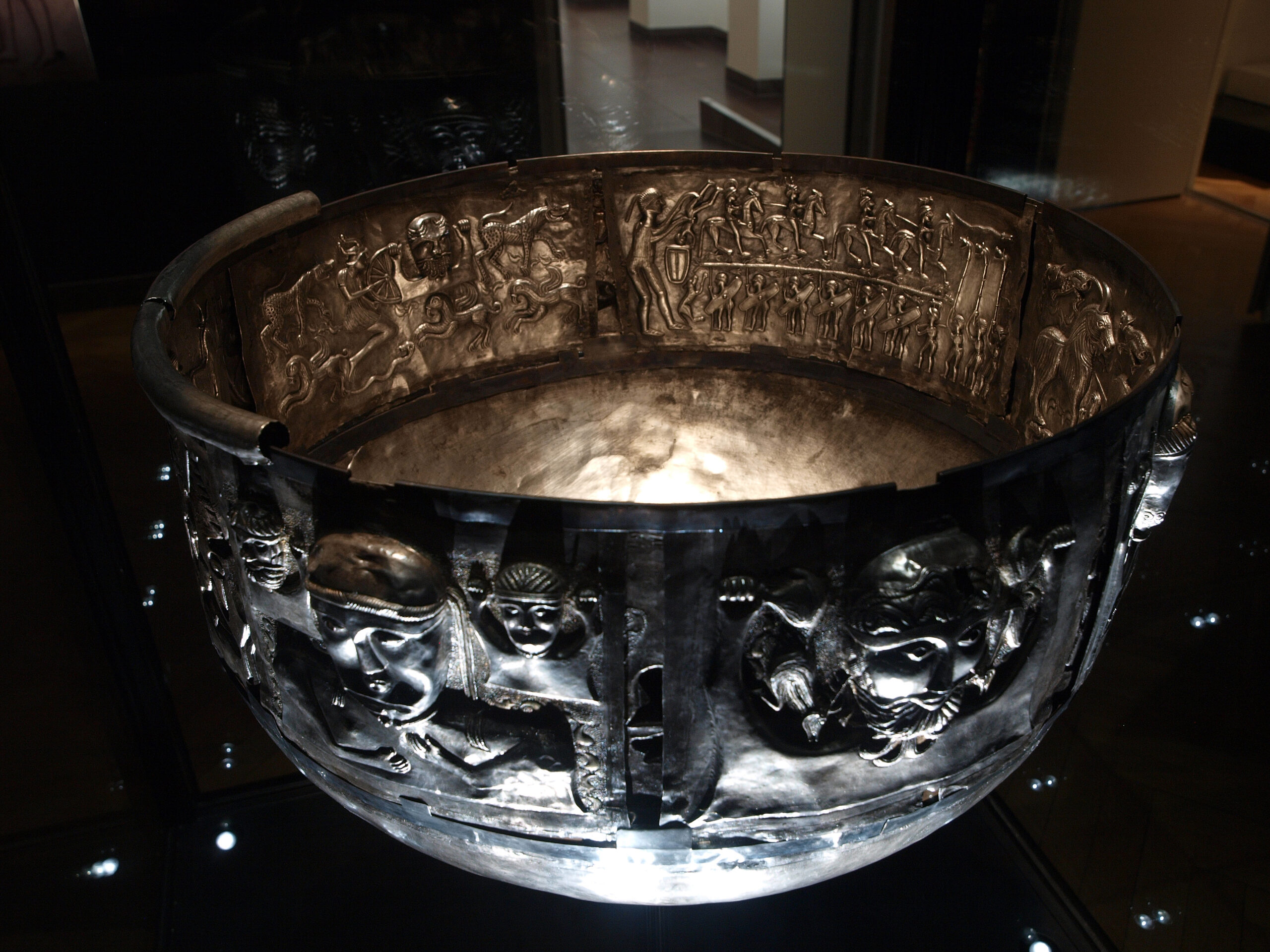
This analogical dynamic finds its counterpart in the Cauldron of Dagda from Celtic mythology (and in the famous Gundestrup Cauldron in silveBy mararie – the gundestrup cauldron, CC BY-SA 2.0, https://commons.wikimedia.org/w/index.php?curid=114575360r and bronze): the vessel from which no one departed unsatisfied and which possessed the power to resurrect fallen warriors. Death is placed into the cauldron; what emerges is renewed life. Understanding the symbolism of the bronze tripod means recognizing this vessel as the universal matrix of regeneration.
4. Comparative Table: The Tripod Between East and West
| Domain | The Tripod of Delphi (Greece) | The Ritual Ding (China) | The Alchemical Cauldron (West) |
| Primary Function | Oracular seat & channel of divination | Ritual vessel & symbol of Royal Power | Cooking vessel (Vasa Hermetis) |
| Active Element | Telluric vapor / Pneuma of Apollo | Sacrificial fire / Food offering | Secret fire (Ignis Noster) |
| Psychic Plane | Ego dissolution (Trance) | Harmony between Ancestors and State | Transmutation of Lead into Gold |
| Final Outcome | The Oracular Word (Logos) | The Mandate of Heaven (Tiānmìng) | The Philosopher’s Stone / Rebis |
Conclusion: Return to the Primordial Cauldron
Whether standing on the slopes of Mount Parnassus at Delphi or across the Yellow River plains in Shang-era China, the symbolism of the bronze tripod reveals a single archetypal obsession of humanity: the need for a stabilized center where raw matter can be burned, cooked, and sublimated.
Modern man has destroyed the tripods and replaced the cauldrons with industrial technology, deluding himself into believing he can master matter without undergoing its sacred transformation. Yet as Calasso’s writings and ancient Eastern wisdom remind us, without a tripod firmly planted across the three worlds and without the fire of the unconscious heating the cauldron, the soul remains raw — incapable of offering the gods the perfume of its own metamorphosis.