Chthonic Eros, Archaic Music, and the Technology of the Sacred Voice
1. FROM MOUSIKĒ TO EROS: THE PHYSICISM OF VIBRATION
To understand the mechanics through which the energy of the XII Astrological House** and the chthonic mass (Eros Pandemos) converts into conscious structure (Logos), we must deconstruct the modern concept of “music.” What contemporary sensibility views as an entertainment art or mere aesthetic abstraction was, for archaic and pre-Socratic thought, a true applied physiology of the pneuma and wave motion.
In the Hellenic world, Mousikē (Μουσική) did not signify a simple combination of notes, but the indissoluble synthesis of poetic word, ritual gesture, rhythmic pulse, and vocal modulation. In both the Symposium and the Phaedrus, Plato explicitly acknowledges this shared root: Eros and Music govern the exact same laws of reconciling opposites. (For a deeper scholarly dive into these classical foundations, see the Stanford Encyclopedia of Philosophy entry on Plato’s Aesthetics and Music).
While Uranian Eros tends toward the abstraction of celestial harmony, the Chthonic Eros (Eros Pandemos) — presided over by the primordial archetype of Polyhymnia — embodies the fundamental frequency of the Earth: visceral drive, gestational rhythm, and the magnetic resonance of the flesh.
2. POLUS HYMNOS: THE VOICE AS WEAVING AND ANCHORING
Prior to her Hellenistic-era reorganization as the Muse of silence and meditation, Polyhymnia (πολύς ὕμνος, the “multiplicity of hymns/unions”) presided over the technology of incantatory recitation (epōdē).
A. The Sacred Hymn as a Wave-Attraction Formula
In archaic chthonic sanctuaries, the hymn was not a prayer of moral petition, but a standing-wave measure. The priestess’s voice, acting through the pneuma (visceral breath), resonated directly with subterranean magma. The chant functioned as a conductor: rather than suppressing the erotic charge, it channeled it along geometric tracks, preventing the voltage of Eros from overwhelming the practitioner’s mind.
B. The Sacred Feminine and the Hierodule
This vocal physicism finds its anchoring point in the figure of the Hierodule (the woman consecrated to the rite) and in the archaic concept of parthenia (virginity as ontological intactness rather than anatomical abstinence). The body and voice of the sacred woman functioned as mass resonators: in ritual union and ecstatic chant, the chthonic charge was received, purified by the voice’s frequency, and grounded—preventing pathological dissolution (nymphomania) while enabling ecstatic inspiration (nympholepsy).
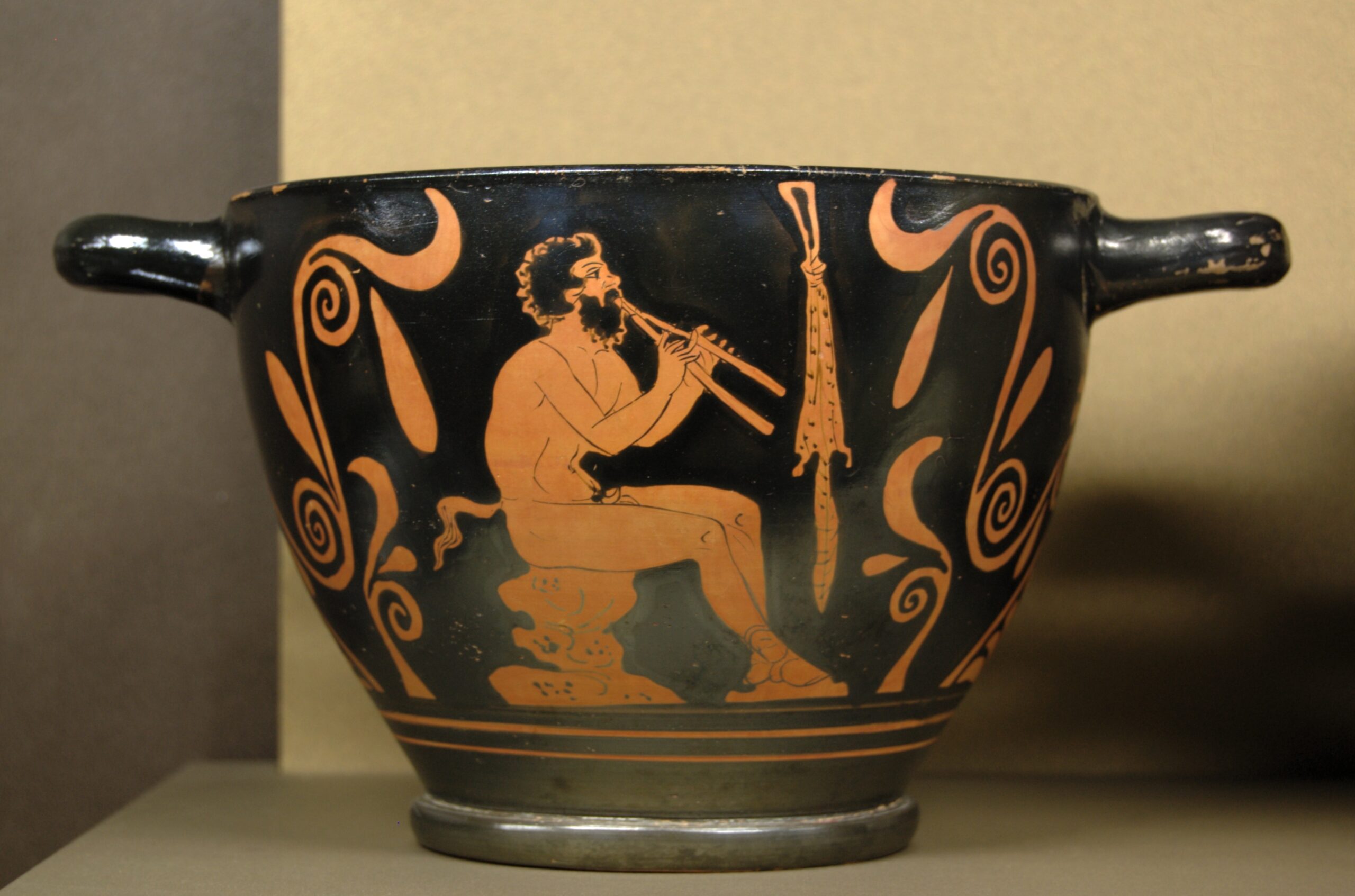
Satyr playing the aulos. Side A from an Lucanian (Metapontium) red-figure skyphos, ca. 400–390 BC. By Creusa Painter – User:Bibi Saint-Pol, own work, 2007-06-15, Public Domain, https://commons.wikimedia.org/w/index.php?curid=2847768
The Satyr playing the *aulos* (a double-reed pipe) embodies an untamed, chthonic, and Dionysian force. The distension of his face and the pressure of his breath (*pneuma*) reveal the physicality of the ritual vibration: the instinctive drive of *Eros Pandemos* is channeled into the *aulos*, demonstrating how sound originates as a bodily and telluric phenomenon before transforming into harmonic structure. (For further insight into the acoustic engineering of the *aulos*, see Reading Aulos Reconstruction Project of the British Museum).
3. CRITICAL AND PROTOPATHIC*** LISTENING GUIDE
To experience this pneuma-erotic dimension acoustically before entering the azimuthal geometry of the primary essay, we recommend a listening path across three specific architectures of sound:
CHTHONIC MATRIX (XII House)
(Undifferentiated magmatic mass)
│
▼
TIBETAN DIPHONIC CHANT
(Sub-systemic resonance frequency)
│
▼
MEDITERRANEAN POLYPHONY & CANTILENA
(Pneuma-erotic charge of the Hierodule)
│
▼
ARCHAIC GREEK RECONSTRUCTION
(Hymn structure and the Logos)
I. The Sub-systemic Frequency (Chthonic Mass of the XII House)
- Phenomenology: The use of sub-harmonics and deep bass registers acts directly on the ribcage and skeletal mass, replicating the effect of telluric saturation.
- Reference Recording: Gyuto Monks Tantric Choir (Tantric Chants).
- Key Track: Sangwa Dupa / Deep Voice Chanting.
II. The Voice of the Hierodule and Telluric Trance (Eros Pandemos)
- Phenomenology: “Open” female vocal style free from bel canto mannerisms, characterized by raw timbres, paeonic rhythms, and visceral diaphragmatic drive.
- Reference Recordings:
- Giovanna Marini & Coro del Galletto di Gallura — Album Passioni (specifically polyphonic tracks like I Nodi).
- Alan Lomax Collection — Italian Treasury: Calabria / Puglia (field recordings of canti a frunza and traditional work chants).
III. The Geometry of the Sacred Hymn (Transition toward Logos)
- Phenomenology: The application of enharmonic modes, microtonal intervals, and asymmetrical rhythms executed on reconstructed string and wind instruments (aulos).
- Reference Recordings:
- Atrium Musicae de Madrid (Gregorio Paniagua) — Album Musique de la Grèce Antique (Harmonia Mundi). Key tracks: Premier Hymne Delphique à Apollon, Hymne à Némésis.
- Ensemble Kérylos (Annie Bélis) — Album D’Euripide à Mésomède: Musiques de l’Antiquité Grecque. Key track: Hymne à Apollon.
Bridge to the Primary Essay:
Once we grasp how pneuma and archaic chant discipline the chthonic vibration of matter, we can translate this exact law from the acoustic sphere into the geometry of inhabited space. The essay that follows details the precise vector and mineral equivalent of this ancient process of incantation and anchoring.
*TITLE FOOTNOTE
Title Note — Structure of the Work and Function of the Prolegomena
This text serves as the introductory and propaedeutic section (from the Greek prolegomena, “things said beforehand”) of the entire volume. Its purpose is to lay down the theoretical, ethnomusicological, and psychological framework required to comprehend the nature of chthonic Eros and wave-matter.
These Prolegomena directly pave the way for the Primary Essay on Polyhymnia (Azimutally-Applied Astrology: Polyhymnia, Eros Pandemos, and Mineral Anchoring), wherein the pneuma-erotic premises outlined here will be translated into the mathematical and vector rigor of high-azimuth astrology, spatial geometry, and mineral domotherapy.
**FOOTNOTE / EXPLANATORY NOTE ON THE XII ASTROLOGICAL HOUSE
In classical and symbolic astrology, the XII Astrological House represents the sector of the Zodiac associated with that which precedes or transcends manifest form. It is the realm of the deep unconscious, the undifferentiated, the primordial womb, and everything residing beneath the threshold of individual awareness.
While the opening houses of the Zodiac build the visible ego and personal identity, the XII House constitutes the “chthonic” or magmatic mass: the reservoir of raw, unchanneled energy not yet reduced to structure (Logos). Within the theoretical frame of this study, the XII House is therefore not interpreted through fatalistic or moral lenses, but as pure wave-matter and energy potential—a force that demands precise geometric and vocal discipline to be grounded and integrated without dissolving the individual self.
***FOOTNOTE / EXPLANATORY NOTE ON PROTOPATHIC LISTENING
Originating in neurology (Henry Head) and depth psychology, the term protopathic refers to a primitive, visceral, and pre-verbal mode of perception. Unlike epicritic sensitivity—which is analytical, discriminative, and capable of isolating details, pitch, and formal melody—protopathic perception operates on a raw, somatic “all-or-nothing” level.
Applied to ancient Mousikē and sound architecture, protopathic listening describes the immediate physical impact of sound waves on the body (such as chest-cavity resonance or rhythmic trance induction) before the conscious mind translates the acoustic signal into logical or aesthetic form. It represents the direct, undifferentiated encounter between the somatic self and the wave-matter of the XII House.