In the pages of The Marriage of Cadmus and Harmony, Roberto Calasso does not limit himself to a mere mythographic recounting. Guided by the intuition and hermeneutic lessons of Giorgio de Santillana and Hertha von Dechend (Hamlet’s Mill) — an authoritative work published in Italy by Adelphi Edizioni — Calasso reconstructs the grammar of a true mythical astronomy. On pages 36 and 37 of his essay, the image of the swing and the mournful gesture of the severed lock of hair merge into a single investigation of celestial mechanics: a rigorous language in which the motion of the stars is translated into bodily, ritual, and erotic imagery.
1. The Physics of the Swing and Solsticial Stasis
When a swing reaches the apex of its trajectory — whether the highest point of its push or the bottom endpoint of its reversal — a paradoxical moment occurs: its vector velocity drops to zero. For an imperceptible fraction of a second, the suspended object “stands still,” floating in immobility before reversing course.
This dynamic stasis is the poetic translation of the solstice (sol-stitium, “the Sun standing still”). The sovereign sun, in its apparent declination along the ecliptic, halts its ascent at the summer solstice or its descent at the winter solstice, only to reverse its path.
- The Vedian Golden Swing: In the Rigveda (VII, 87, 5), the god Varuna places a “golden swing” (hiraṇyayīṁ preṅkhām) in the heavens. This image is not a poetic embellishment, but a key code for deciphering mythical astronomy: the Sun is the suspended pendulum that the god swings between the two extremes of the solar year.
- The Satyr’s Eros in the Aiora: In Attic vase iconography, the act of swinging is often assisted by a Satyr. The Dionysian element introduces an erotic component: the back-and-forth movement suggests generative rhythm, while the apex stasis fuses the ecstasy of Eros with the terror of suspension. Pushing the swing ensures the continuation of the cosmic cycle through controlled vertigo.

2. The Myth of Erigone and the Origins of the Aiora
The ritual application of this celestial mechanics finds its most tragic and fascinating manifestation in Athens in the rite of the Aiora (in greek, “suspension” or “swing”), celebrated during the Anthesteria festival. The roots of the rite reach deep into Attic Dionysian myth:
- The Death of Icarius: Icarius welcomes Dionysus and receives the gift of the vine. When he offers wine to the local shepherds, they mistake drunkenness for poisoning, murder him, and hide his body under a tree.
- The Hanging of Erigone: Guided by her faithful dog Maera, his daughter Erigone discovers her father’s grave. Overcome with grief, she hangs herself from the branches of the same tree, casting a curse upon all the maidens of Athens.
- The Curse and Catharsis: A plague of madness causes young Athenian women to hang themselves en masse. The Delphic Oracle decrees the institution of the Aiora: to appease Erigone’s shadow without sacrificing more lives, maidens swing suspended from trees, simulating death to transform it into an aerial dance.
Understanding mythical astronomy reveals the final catasterism: Erigone is immortalized in the heavens as the constellation Virgo, Icarius becomes Boötes, and the hound Maera becomes the star Sirius.
3. The Severed Lock and the Axial Precession
On page 37, Calasso pairs the stasis of the swing with the mournful gesture of the severed lock of hair (koplē). Isis cuts off a lock upon learning of Osiris’s dismemberment, just as Erigone and the Attic maidens cut their hair before suspending themselves.
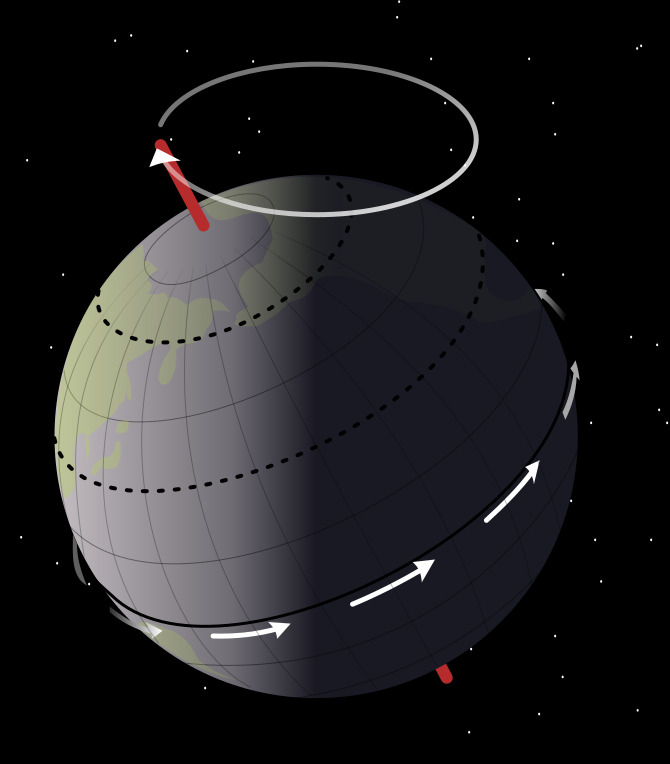
In the code of Hamlet’s Mill, the severed lock visually illustrates the rupture of the axis of the world (Axis Mundi):
- Solsticial Oscillation: Depends on the Earth’s axial tilt (about 23°) relative to the ecliptic plane. It represents the regular oscillation of the solar year.
- Precessional Oscillation: Due to gravitational pull, Earth’s axis undergoes a slow conical rotation (the precession of the equinoxes) lasting approximately 25,772 years (the Great Year).
Viewed from the celestial sphere, the trajectory of the axis traces a closed spiral — a geometric “lock of hair.” When an astrological era draws to a close — marked by the death of the Golden Age deity (Osiris, Kronos, Icarius) — the equinoctial point shifts relative to the zodiac. Cutting the lock signifies acknowledging that the axis has drifted out of alignment: the millstone of heaven has slipped, and time has ruptured to usher in a new era.
Summary of Astronomical-Mythological Correspondences
| Mythic Element | Celestial Mechanics | Ritual / Symbolic Value |
| Swing (Aiora) | Solar Stasis at Solstices | Suspension between life and death; halting and reversal of time |
| Pushing Satyr | Dynamic Cycle Reversal | Dionysian and erotic impulse renewing nature |
| Severed Lock | Precession of the Equinoxes | Axial misalignment; fracture and shift of Eras |
| Erigone / Virgo | Transition of the Guide Constellation | Celestial marker of sideral turning points |
Conclusion
The work of Roberto Calasso demonstrates that mythical astronomy serves as a highly sophisticated conceptual language capable of preserving precise astronomical observations in the form of human drama. The swing pausing at its zenith represents solsticial ecstasy; the severed lock measures precessional rupture. Through the inextricable weaving of Eros, grief, and geometry, ancient tradition turns the rigid mechanics of the spheres into a living mythology, where every human ritual repeats the secret rhythm of the cosmos.