Introduction: The Metamorphosis of the Cosmic Archetype
When the final Pharaonic dynasties gave way to Hellenistic and Roman rule, the complex theological structure of ancient Egypt did not vanish into thin air. Its deepest core—Psychostasia, or the weighing of the heart described in Chapter 125 of the Book of the Dead—transcended the boundaries of the Nile Valley to embed itself in the collective imagination of the entire Mediterranean basin. The solemn scene in the Hall of the Two Truths (Maaty), where the deceased’s heart (Ib) was measured on a balance scale against the feather of the goddess Maat, proved to be too powerful a conceptual framework to remain confined solely to Egyptian religion.
Over the centuries, this cosmic drama underwent a profound cultural translation. Refiltered and reassembled within the codes of Judaism, mainstream Christianity, and the heterodox currents of Hermetism and Gnosticism, Psychostasia ceased to be exclusively a post-mortem trial and converted into a map for inner transformation. This essay traces the line of continuity linking the ancient Egyptian physics of the soul to Western eschatology and initiatic mysticism.
Chapter 1: From Maat to Sinai — The Egyptian Imprint on Biblical Law and Poetics
The formation of Jewish thought unfolded through a rigorous, dialectical dialogue with Egyptian civilization. As recorded in the Acts of the Apostles (7:22), “Moses was educated in all the wisdom of the Egyptians”, an insight validated by modern scholarship that identifies the absorption and reinterpretation of Egyptian theological categories within Mosaic culture.
1.1 The Physics of the Heart in the Old Testament
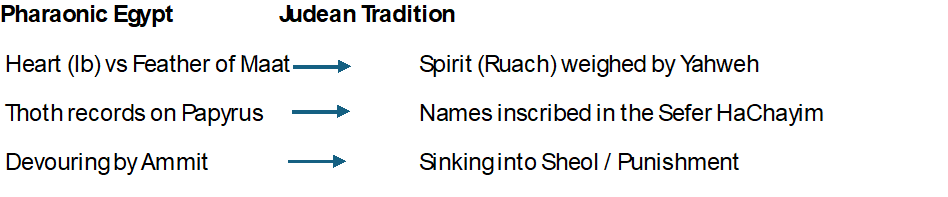
In biblical Jewish tradition, divine judgment mirrors the conceptual structure of measuring the soul. The Exodus narrative offers a striking linguistic and theological parallel in the hardening of Pharaoh’s heart. In the Hebrew text, the moral condition of the Egyptian monarch is described using the verb kaved (“to be heavy” or “to grow heavy”). A heavy heart is dense with stubbornness and disorder, incapable of floating in divine harmony—a direct conceptual rendering of a heart weighted down by Isfet (chaos), condemned in psychostasia.
The metaphor of divine scales as an instrument of ontological and moral evaluation recurs systematically throughout wisdom and prophetic literature:
- Proverbs 16:2 & 21:2: “All a person’s ways seem pure to them, but motives are weighed by the Lord”. Here the Hebrew verb takan specifically denotes precision measurement of incorporeal substance.
- Job 31:6: The righteous sufferer explicitly invokes the rite of balance: “Let God weigh me in honest scales and he will know my integrity”.
- Daniel 5:27: In the famous vision at King Belshazzar’s feast, a mysterious hand writes the sentence Mene, Tekel, Upharsin. Daniel’s interpretation of Tekel directly echoes the archetype: “You have been weighed on the scales and found wanting”.
1.2 The Register of Thoth and the Book of Life
Beside the scales, the figure of Thoth—the divine scribe marking the final verdict with his stylus—finds its counterpart in the biblical Sefer HaChayim, the “Book of Life” (Exodus 32:32-33; Psalms 69:28). In this celestial ledger, transcendent action records the spiritual imprint of the individual. Eradication from the divine book is identical to the fate reserved for the guilty devoured by Ammit: ontological oblivion and the loss of immortality.
Chapter 2: The Archangel’s Scales — The Eschatological Transit into Christianity
With the rise of Christianity in medieval Europe, the visual and functional heritage of Osiris’s court did not vanish; rather, it was absorbed into the theology of the Last Judgment. The roles of ancient underworld deities were reassigned to the angelic hierarchy and Catholic demonology.
2.1 Saint Michael as the New Psychopomp and Judge
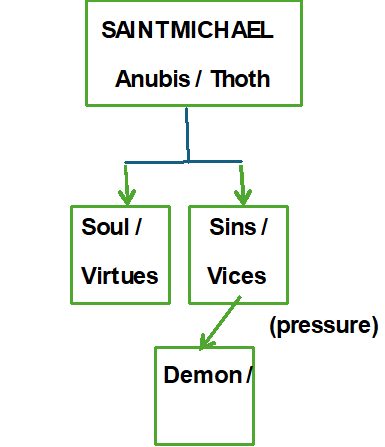
Saint Michael the Archangel inherited the historic prerogatives of Anubis (psychopomp and calibrator of scales) and Thoth (recorder and executor of divine measure).
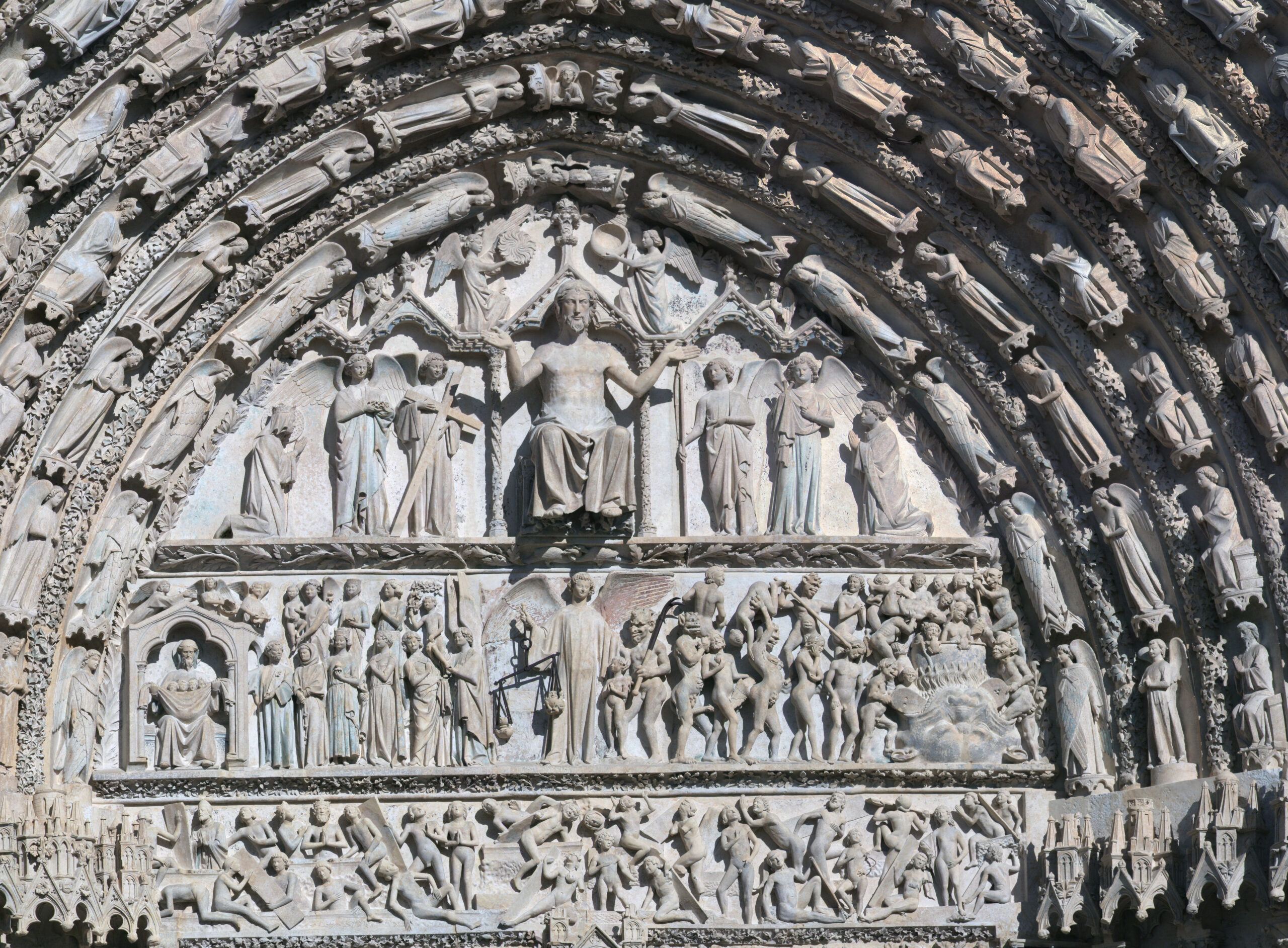
On the carved portals of great Romanesque and Gothic European cathedrals—such as Bourges, Autun, Conques, or Notre-Dame de Paris—psychostasia is presented with striking iconographic fidelity:
- The Archangel stands at the center holding precision scales. Resting upon the pans are no longer an ostrich feather and an organic heart, but a stylized representation of the soul or its good deeds opposed to sins.
- The Demon, crouched beneath the scales, attempts to claw down the pan of sins to drag the soul to hell. This demonic figure is the direct heir to Ammit, the triform Egyptian monster (“the Devourer”) who waited at the foot of the scales.
2.2 The “Second Death” in Revelation
The Book of Revelation (20:12-14) codifies the concept of the second death, a notion clearly rooted in Egyptian theology. In Chapter 125 of the Book of the Dead, a condemned soul does not face eternal imprisonment, but devouring by Ammit, resulting in total annihilation of consciousness and a “second death” (mwt m whm). Similarly, John’s apocalypse distinguishes biological death from the “second death”—being cast into the lake of fire if one’s name is not found “written in the Book of Life.”
Chapter 3: The Alexandrian Code — Esotericism, Gnosticism, and the Rebirth of the Initiate
While popular and esoteric Christianity assimilated the iconography of scales, the intellectual melting pot of Alexandria (1st–3rd centuries CE) reframed the rite: psychostasia was not a trial deferred to the afterlife, but a theurgic and initiatic technique to be accomplished while living.
3.1 The Osirian Christ and the Flight into Egypt
In wisdom traditions, the Flight into Egypt (Matthew 2:13-15) serves as an allegorical narrative of Jesus’s apprenticeship in the temples of Heliopolis and Thebes. Christ is read as the fulfillment of the Osirian archetype:
- Osiris is the dismembered and resurrected god, the first to navigate the Duat to make eternal life accessible.
- Christ embodies the historical manifestation of the Logos overcoming material death. His harrowing of hell prior to resurrection mirrors the solar descent of Ra/Osiris to the subterranean nadir.
- Baptism represents the water catharsis that purifies the subtle body before entering the Hall of Truth, while the Sacred Heart (and the Grail tradition) restores the Ib organ as a pure vessel containing divine consciousness and universal love.
3.2 Celestial Customs (Telonia) in Gnosticism
In the Nag Hammadi texts and the Pistis Sophia, underworld geography shifts to planetary spheres ruled by Archons (tyrannical rulers of the material world).
The soul’s ascent becomes a dramatic passage through “celestial customs” (Telonia):
- The Archontic Accusation: Each planetary ruler detains the soul, attempting to measure its material weight by citing its attachments to flesh, desire, and ignorance (Agnosia). Heavy souls are cast back down to reincarnate, experiencing the equivalent of Ammit’s devouring.
- Gnosis as the New Heka: To pass the guardians, the Gnostic initiate proclaims secret words of knowledge (Paradosis) acquired during mystery rites. Just as the Egyptian deceased recited the Negative Confession to refute the 42 judges, the Gnostic affirms their divine nature: “I am a child of the Inviolable Father, my origin is from the Pre-Principle, and I transcend your measure”.
3.3 The Hermetic Way and Alchemical Transmutation
In the Corpus Hermeticum, attributed to Hermes Trismegisto (a syncretic fusion of Thoth and Hermes), psychostasia turns inward, becoming the regeneration of the Nous (the Divine Mind).
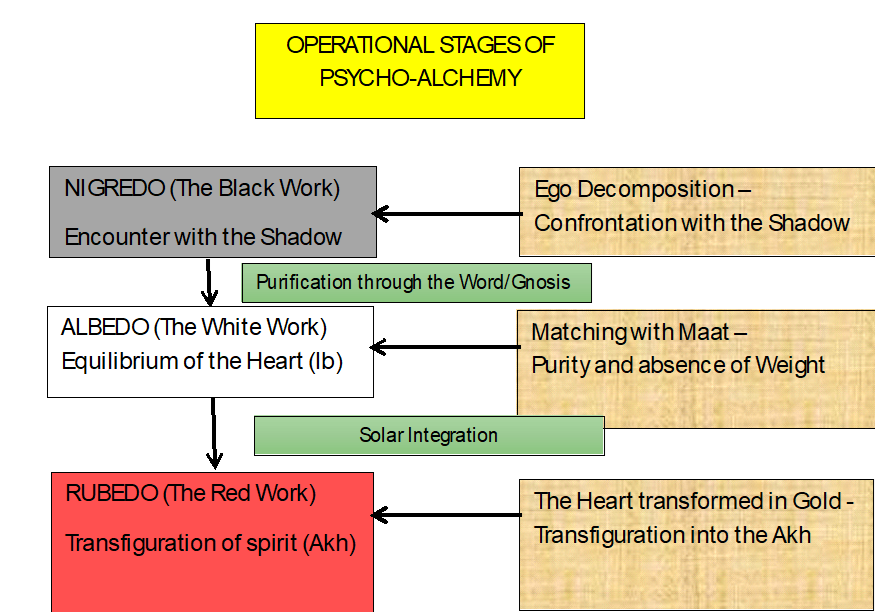
This process directly inspired alchemy (derived from Al-Khem, “the Black Land” of Egypt):
- Nigredo and Ammit: The alchemical phase of dissolution demands an encounter with the Shadow and unconscious monsters. Those lacking purity of intent are consumed by their own madness (Ammit).
- Albedo and Maat’s Feather: Attaining the White Work represents freeing matter from earthly dross. The heart/philosophical mercury matches the lightness of the feather: the mind achieves detachment, clarity, and complete absence of egoic gravity.
Conclusion: The Eternity of the Inner Scales
The historical trajectory of Psychostasia demonstrates that ancient Egypt bequeathed to the West far more than a funerary myth. Through Jewish transmutations, medieval iconographic codifications, and Alexandrian esoteric speculations, the weighing of the heart stands revealed for what it always was: a fundamental principle of ontology and depth psychology.
From Maat’s ancient feather to Saint Michael’s scales and the alchemical purification of the Nous, the ultimate lesson of psychostasia remains unchanged: spiritual evolution is not measured by adherence to a punitive dogmatic code, but by the transparency of consciousness. Only a heart that has integrated its shadow and shed the weight of the ego can transcend material bounds, match the lightness of the feather, and awaken to the light of immortality.